61° and Overcast


Image

The superintendent proposes. The Board of Education scrutinizes, challenges and decides. When board members repeatedly approve the administration’s recommendations without providing convincing answers to community concerns, residents have every reason to ask: Who is actually holding Superintendent David Aderhold accountable?
Dana Krug’s campaign advertises more than 15 years on the West Windsor–Plainsboro Board of Education and her current position as chair of the Finance Committee. That experience brings responsibility. It also makes the absence of satisfactory answers harder to excuse.
My review of district financial records identified more than $50 million in accumulated health-insurance budget variances over multiple years. These are differences between what the district budgeted and what it actually spent. In my view, their size and recurrence raise serious questions about how much taxpayers were asked to contribute and why those budgeting assumptions continued.
Where was the sustained challenge from Krug? What corrections did she demand? What explanation can she give taxpayers for the repeated discrepancies and the subsequent use of those funds?
A finance chair should challenge the numbers before taxpayers have to investigate them.
Residents should not have to submit repeated public-records requests to understand why substantial amounts budgeted for one purpose remained unspent or where that money ultimately went. Providing understandable answers is a basic obligation of financial oversight.
Krug cannot campaign on her experience while avoiding accountability for the decisions made during that experience. If she believes the administration’s budgeting was justified, she should defend it with a clear, year-by-year explanation. If she believes changes were necessary, she should identify what she did to secure them.
Then there is the $4.25 million purchase of 72 Grovers Mill Road, which Krug and Shwetha Shetty supported.
The district’s responses to my public-records requests have not supplied the capacity analysis or comparative lease-versus-purchase study I sought. That leaves fundamental questions unanswered: Why purchase rather than continue leasing? What existing district space was evaluated? What alternatives were rejected, and on what financial grounds?
Supporting an important educational program does not automatically justify a particular real-estate purchase. The board still has to establish that the chosen investment is necessary, financially sound and preferable to available alternatives.
Why did these board members say yes without ensuring that the community received those answers?
Agreement with Aderhold is not itself a failure. But board members must demonstrate independent judgment. What assumptions did they challenge? What additional evidence did they require? What would have made them vote no?
If the public sees approval after approval but cannot see meaningful scrutiny, the impression of a rubber-stamp board is entirely understandable.
Shetty’s campaign emphasizes her professional background in student mental health. That makes her response to the issue of later school start times particularly important.
The American Academy of Pediatrics recommends that middle and high schools aim to start no earlier than 8:30 a.m., citing the potential benefits for adolescent health, safety and learning. Yet families seeking healthier schedules have been told that costs and logistics make implementation difficult.
What has Shetty done to challenge that conclusion? What alternatives has she demanded? What concrete path forward has she proposed?
A committee’s finding that change is expensive should prompt a board committed to student mental health to examine solutions, costs and tradeoffs. It should not end the discussion indefinitely.
Approving a building purchase does not prove that someone is indifferent to mental health. But campaigning on mental health invites scrutiny of whether that priority produces action when the administration raises objections.
Mental health deserves the same determination to find a solution that the board demonstrated in approving a property purchase.
I cannot know why Krug or Shetty votes as she does. Their responsibility is to explain those votes with evidence and demonstrate that they serve the community’s interests.
Aderhold’s recommendations should face rigorous examination. His administration should have to explain recurring budget discrepancies, justify major purchases and respond substantively to residents.
That is the board’s job.
After years in office, credentials and assurances are insufficient. Krug and Shetty should show us where they challenged Aderhold, what they required him to change and how their oversight improved the outcome.
If they cannot demonstrate that accountability, voters should question whether they deserve another term.



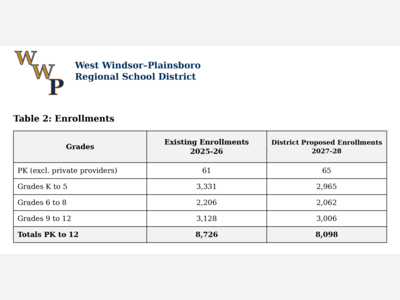
I would like to see the Long Range Forecast you cited. I have been tracking enrollment for over 5 years. The 8098 projected enrollment would represent a 17% decrease in enrollment over the past 10 years!
Stephen I sent you 2 emails with all the information. Full disclosure, the information that I sent you came directly from Aderhold or his administration.

Sunny, with a high of 62 and low of 42 degrees. Overcast in the morning, clear in the afternoon and evening, cloudy overnight.

I read that Dana Krug is Chairwoman of the Finance Committee of the WW school board, which means to me that she is the right person to respond to Mehno's very reasonable inquiries. My hopes are that Ms. Krug will respond adequately according to her duties and capacity as Chairwoman.
I will give her the benefit of the doubt. But Krug never responds to any inqueries.....she is not approachable nor she cares.


Is all of that $54.3M accounted for and where is it?
That is a question that I have been asking Aderhold and I have not received any answer. I do not know where it went.
We taxpayers are fortunate to have Veronica Mehno as such a concerned and knowledgeable member of our community, and I echo her concerns about the expenditures and practices of the West Windsor school administrators.
I hope Aderhold will respond to my complaint submitted to the Education Department. I have been asking the same 2 questions since August 17, 2026 and Aderhold responds by telling me that money surplus can be legally transferred to the capital reserves account.
Would it be able to contact you offline? My name is Dr.Amar Atre. I am running for BOE for WW-P in the coming election. My e-mail is atreboe@gmail.com. Number is 404-617-5969.

I request that Superintendent Aderhold respond to the questions Virginia Mehno raises. And also, why would later school start times result in additional buses and drivers with higher fuel costs?
Enrollment has dropped about 10% over 15 years. This is a trend not unusual for other districts. Adding capacity makes no sense.

Veronica, have any of the following resources been contacted to complete an investigative audit?
The question is not whether the transfers were legal or properly recorded.