58° and Overcast


Image

Transparency is not demonstrated by producing pages of accounting terminology. It is demonstrated by answering reasonable questions clearly, directly, and honestly.
For eight consecutive fiscal years—from 2018 through 2025—the West Windsor-Plainsboro Regional School District budgeted substantially more for health benefits than it ultimately spent. According to the District’s audited financial records, the cumulative favorable variance in this single budget category was approximately $40.9 million.
That extraordinary eight-year pattern raises two basic questions:
Why did the District repeatedly overbudget health-benefit expenditures for eight consecutive years?
How were the resulting annual favorable variances ultimately used?
Superintendent David Aderhold has been given opportunities to answer these questions. Instead of providing a direct explanation, he has responded with lengthy discussions of fund accounting, reserves, statutory procedures and budget terminology.
None of that answers the questions.
The community is not asking Superintendent Aderhold to identify the path of every individual tax dollar. We are asking why the same major expenditure category was materially overbudgeted year after year—and what happened to the General Fund resources that were budgeted for health benefits but were not ultimately needed for that purpose.
A meaningful answer should identify the assumptions used to prepare each health-benefit budget: projected premium increases, anticipated enrollment, staffing estimates, contingency allowances and any other factors incorporated into the calculations. It should also explain whether the District changed its forecasting methodology after actual expenditures repeatedly came in below budget.
If the District’s projections were reasonable, the administration should be able to show the community the calculations. If unexpected circumstances produced the favorable variances, it should identify those circumstances. If the forecasting methodology repeatedly proved inaccurate, the public deserves to know why it was not corrected.
The second question is equally important. How were these annual favorable variances ultimately reflected in year-end fund balance, transfers, reserves, encumbrances, later budgets or tax relief?
This is particularly relevant because WW-P imposed local tax-levy increases of approximately 2.819% for 2024–25, 5.223% for 2025–26 and 4.682% for 2026–27—three consecutive increases above 2%.
The audited records also establish recurring favorable General Fund results and repeated deposits into and withdrawals from Capital Reserve. The District’s own 2018 referendum materials acknowledged that the Board could weigh tax relief against contributions to Capital Reserve, or choose a combination of the two.
Therefore, asking whether some available General Fund resources could have provided tax relief is not evidence of misunderstanding public-school accounting. It is a legitimate policy question about the choices made by the superintendent and Board of Education.
No responsible analysis should claim, without supporting evidence, that every dollar of the $40.9 million came directly from current property taxes or that one particular reserve transfer caused a subsequent levy increase. But those accounting limitations do not erase the documented eight-year pattern—and they do not excuse the administration from explaining it.
This has now become a serious transparency issue for the WW-P community.
The concern is no longer limited to how accurately one budget category was forecast. The concern is why the superintendent will not provide a direct, documented answer to two straightforward questions involving approximately $40.9 million.
Taxpayers should not have to decode accounting lectures, search through hundreds of pages of financial reports or repeatedly reformulate the same questions to obtain basic information about their school district’s finances.
Transparency requires more than publishing documents. It requires officials to explain the decisions reflected in those documents and to answer the public when legitimate concerns are raised.
After eight consecutive years and approximately $40.9 million in cumulative favorable health-benefit variances, the community deserves more than deflection.
It deserves an answer.
Veronica Mehno

Veronica, have any of the following resources been contacted to complete an investigative audit?
New Jersey, school district finances are subject to several layers of oversight. If the community or the state demands an independent, investigative, or forensic audit beyond the routine Annual Comprehensive Financial Report (ACFR), it is typically performed by one of the following entities:
The question is not whether the transfers were legal or properly recorded. The question is whether eight consecutive years of excessive health-insurance appropriations created a recurring surplus that the administration then used, with BOE approval, to build Capital Reserve instead of reducing the burden on taxpayers

Overcast, with a high of 64 and low of 58 degrees. Overcast in the morning, light rain for the afternoon, light rain shower during the evening, overcast overnight.


Is all of that $54.3M accounted for and where is it?
That is a question that I have been asking Aderhold and I have not received any answer. I do not know where it went.
We taxpayers are fortunate to have Veronica Mehno as such a concerned and knowledgeable member of our community, and I echo her concerns about the expenditures and practices of the West Windsor school administrators.
I hope Aderhold will respond to my complaint submitted to the Education Department. I have been asking the same 2 questions since August 17, 2026 and Aderhold responds by telling me that money surplus can be legally transferred to the capital reserves account.
Would it be able to contact you offline? My name is Dr.Amar Atre. I am running for BOE for WW-P in the coming election. My e-mail is atreboe@gmail.com. Number is 404-617-5969.

I request that Superintendent Aderhold respond to the questions Virginia Mehno raises. And also, why would later school start times result in additional buses and drivers with higher fuel costs?
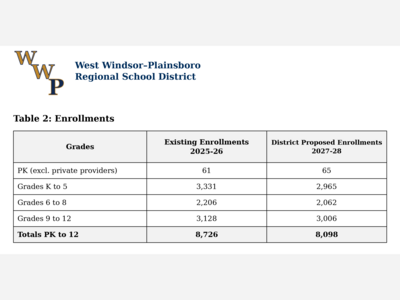
Enrollment has dropped about 10% over 15 years. This is a trend not unusual for other districts. Adding capacity makes no sense.

Veronica, have any of the following resources been contacted to complete an investigative audit?
The question is not whether the transfers were legal or properly recorded.