Image

I have now reviewed the district's October 19, 2026 response to my three Open Public Records Act requests, along with the accompanying documents.
I find the district's disclosures deeply troubling.
After years of assurances about fiscal responsibility, transparency, and the careful stewardship of taxpayer dollars, the administration and Board have now confirmed in writing that they possess no responsive records documenting certain fundamental analyses that should inform a $4.25 million real estate acquisition.
The question is no longer simply why the district purchased 72 Grovers Mill Road. The question is how the Board justified spending $4.25 million without producing documented comparisons demonstrating that purchasing the property was preferable to the available alternatives.
In my OPRA request, I specifically sought feasibility studies, facility assessments, reports, and presentations evaluating whether the programs operating at 72 Grovers Mill Road could be accommodated in existing district-owned buildings.
The district's response was unequivocal:
"No responsive records exist."
I also requested financial analyses comparing the purchase with continued leasing or relocating programs into existing district facilities, including projected maintenance, utilities, renovations, staffing, and operating costs.
Again, the district reported that no responsive records exist.
Let me emphasize what this means.
The administration recommended a $4.25 million property acquisition, and all nine Board members voted in favor of that purchase.
Yet the district cannot produce responsive records comparing the financial consequences of purchasing the property against continuing to lease it or utilizing facilities taxpayers already own.
How is that consistent with responsible financial oversight?
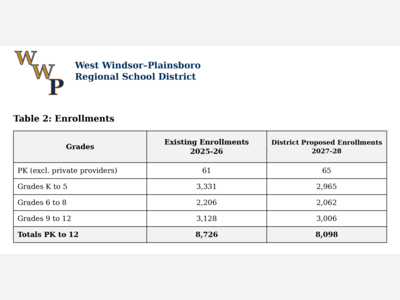
The documents provided by the district include the New Jersey Department of Education's April 29, 2026 Long-Range Facilities Plan amendment.
According to that document:
These are not estimates that I have independently invented. They appear in the district's own facilities planning documentation submitted to the NJDOE.
The district's existing capacity exceeds projected enrollment by approximately 1,355 student places.
While I recognize that surplus capacity does not necessarily mean every classroom is suitable for every educational program, that is precisely why a documented feasibility assessment should have been undertaken.
If the district projects declining enrollment and substantial surplus capacity, why was the purchase of an additional property considered necessary without a documented evaluation of existing alternatives?
The March 24, 2026 resolution approving the acquisition passed unanimously, with all nine Board members voting in favor.
Every Board member has a responsibility to exercise independent judgment when approving significant expenditures of public funds.
I therefore ask each Board member:
What financial comparison did you review before voting?
What documentation established that purchasing the property was more advantageous than continuing the lease?
What evidence demonstrated that the programs could not be accommodated in existing district-owned buildings?
Did any Board member request an independent financial analysis?
And if no such analysis was available, on what basis did you conclude that this expenditure represented a prudent use of taxpayer funds?
A unanimous vote does not substitute for documented due diligence. Time for Krug and Shetty to be removed from the BOE.
The district produced a February 2026 appraisal estimating the property's market value at $4,350,000.
The purchase price was $4,250,000.
I acknowledge that the purchase price was $100,000 below the appraised value.
However, purchasing property below its appraised market value does not, by itself, demonstrate that the acquisition was necessary or financially preferable to the alternatives.
A property can be fairly priced and still represent an unnecessary expenditure.
The relevant question is not simply whether the district paid a reasonable market price.
The relevant question is whether purchasing the property was the most responsible use of $4.25 million in public funds.
The district's response has not established that conclusion.
The April 2026 Long-Range Facilities Plan identifies J.V.B. Wicoff Elementary School under renovation and building addition.
Yet the district's October 19 response states that no responsive records exist for several categories of requested documents, including plans, approvals, professional-service and construction contracts, and comparisons with earlier referendum work.
This raises additional questions about the accuracy, completeness, and transparency of the district's capital planning.
Is the Wicoff entry a newly proposed project, unfinished work, or a continuation of previously completed construction?
What additional expenditure, if any, is contemplated?
What is the educational justification?
And why are the requested supporting records unavailable?
Taxpayers should not have to repeatedly submit OPRA requests simply to understand what the district intends to construct and how much it may cost.
These disclosures are especially concerning in light of my longstanding questions regarding the district's health-insurance budgeting practices and the substantial favorable variances accumulated over multiple fiscal years.
I have previously raised concerns regarding approximately $54 million in cumulative favorable health-insurance budget variances over an eight-year period.
Those figures and the district's accounting treatment warrant independent examination.
I am not suggesting that the OPRA response establishes an improper transfer or unlawful expenditure.
However, when substantial budget variances coexist with significant capital spending, taxpayers are entitled to understand precisely how financial decisions are made.
Was the acquisition evaluated against other educational priorities?
What alternatives were presented to the Board?
What criteria were used to determine that this purchase deserved priority over other district needs?
And how does the district reconcile continued capital expenditures with declining enrollment and its repeated emphasis on financial constraints?
The district has supplied 570 pages of records.
I appreciate the production of existing documents. However, producing a large volume of records does not necessarily demonstrate that the underlying decision-making was sufficiently rigorous.
The most consequential information is not the number of pages produced.
It is the district's express acknowledgment that certain financial comparisons and alternative-facility analyses were not found.
Furthermore, the district denied access to classroom-utilization schedules on security grounds.
I understand the importance of protecting students and staff. However, I see no reason why the district cannot provide aggregate figures identifying the number of vacant, unassigned, or partially utilized classrooms by building without revealing individual classroom locations, student movements, or daily schedules.
That information is essential to evaluating whether the district is managing its existing facilities efficiently.
I am requesting that Dr. Aderhold and the Board provide a substantive written explanation addressing the following:
These questions seek an explanation of decisions already made. They are separate from my rights under OPRA to obtain existing government records.
For years, this administration has spoken about transparency, responsible budgeting, and respect for taxpayers.
Those principles must be demonstrated through actions, not merely repeated in public statements.
The district is projecting hundreds fewer students and substantial surplus capacity. Nevertheless, the Board unanimously authorized another multimillion-dollar property acquisition without producing responsive records of fundamental financial and facility-alternative comparisons.
That is a legitimate and serious concern about the quality of financial oversight.
I am not alleging that the purchase was unlawful. I am questioning whether the administration and Board exercised the level of documented financial diligence that taxpayers have every right to expect.
The community deserves more than assurances that the administration believes a purchase is beneficial.
It deserves the evidence, reasoning, and financial comparisons supporting that conclusion.
I request a substantive written response within ten business days and ask that these issues be addressed publicly by the Board.
Still the community has been overtaxed by $50MM in the past 13 years and Aderhold not has not given an explanation where that money has gone.
This administration does NOT believe in transparency nor community engagement. This administration wants to do whatever they want without being held accountable. This is proof of it.
Veronica Mehno
West Windsor-Plainsboro Resident and Taxpayer



I read that Dana Krug is Chairwoman of the Finance Committee of the WW school board, which means to me that she is the right person to respond to Mehno's very reasonable inquiries. My hopes are that Ms. Krug will respond adequately according to her duties and capacity as Chairwoman.
I will give her the benefit of the doubt. But Krug never responds to any inqueries.....she is not approachable nor she cares.

Sunny, with a high of 63 and low of 43 degrees. Sunny for the morning, overcast during the afternoon and evening, clear overnight.


Is all of that $54.3M accounted for and where is it?
That is a question that I have been asking Aderhold and I have not received any answer. I do not know where it went.
We taxpayers are fortunate to have Veronica Mehno as such a concerned and knowledgeable member of our community, and I echo her concerns about the expenditures and practices of the West Windsor school administrators.
I hope Aderhold will respond to my complaint submitted to the Education Department. I have been asking the same 2 questions since August 17, 2026 and Aderhold responds by telling me that money surplus can be legally transferred to the capital reserves account.
Would it be able to contact you offline? My name is Dr.Amar Atre. I am running for BOE for WW-P in the coming election. My e-mail is atreboe@gmail.com. Number is 404-617-5969.

I request that Superintendent Aderhold respond to the questions Virginia Mehno raises. And also, why would later school start times result in additional buses and drivers with higher fuel costs?
Enrollment has dropped about 10% over 15 years. This is a trend not unusual for other districts. Adding capacity makes no sense.

Veronica, have any of the following resources been contacted to complete an investigative audit?
The question is not whether the transfers were legal or properly recorded.