50° and Clear


Image

For years, Superintendent David Aderhold has told parents that later school start times are financially difficult because the district would need additional buses and drivers and would face higher fuel costs.
We are told there is not enough money to address parents’ concerns about adolescent sleep, student health and the 7:40 a.m. high-school start time.
But apparently, there is money for the administration’s priorities.
The district purchased approximately 28 acres at 221 Southfield Road for $3.9 million as a possible site for another school—even as WW-P’s student enrollment has declined. It subsequently proceeded with a Phase 2 architectural and archaeological evaluation of that property. The community still has not received a clear public explanation of that study’s outcome, total cost or the district’s current plans for the land.
Now the district is pursuing the acquisition of 72 Grovers Mill Road in Plainsboro, a property it has already leased and improved using public funds.
These decisions must be examined alongside another troubling financial pattern: for eight consecutive years, WW-P budgeted substantially more for employee health benefits than it ultimately spent. Based on the district’s own audited financial statements, those cumulative budget-to-actual differences totaled approximately $40.9 million.
That is not a minor forecasting error. It is a repeated pattern involving money collected from taxpayers but not spent for the purpose used to justify the budget.
At the end of each year, the administration asks the Board of Education to transfer millions of dollars in available balances into Capital Reserve. Once transferred, that money becomes restricted for authorized capital purposes. It is no longer readily available for ordinary operating expenses such as bus-driver salaries.
This creates a self-reinforcing cycle.
First, taxpayers are asked to fund budgets containing health-benefit projections that repeatedly exceed actual spending. Next, the resulting year-end balances are transferred into Capital Reserve. Then, when parents request an operating change—such as later school start times—the administration says it cannot afford the recurring transportation costs.
But the money did not simply disappear. The administration and Board made choices about where to place it and what priorities it would support.
Capital Reserve may be lawful. Purchasing property may be lawful. Conducting studies may be lawful. But legality alone does not establish fiscal responsibility, educational necessity or alignment with community priorities.
The central question is simple: Why is WW-P accumulating land and advancing capital plans while enrollment is declining, yet dismissing a student-health concern because additional drivers and fuel supposedly cost too much?
If purchasing 221 Southfield Road was necessary, the administration should release the enrollment projections and facilities analysis supporting the need for another potential school site. It should disclose the complete cost and findings of the Phase 2 evaluation and explain the property’s current intended use.
If purchasing 72 Grovers Mill Road is financially preferable to continuing the lease, the administration should release the appraisal, proposed purchase price, lease-payment history, improvement costs and lease-versus-purchase analysis.
And if later school start times are truly unaffordable, the administration should disclose the detailed cost estimate, transportation alternatives considered and an explanation of why that student-centered investment ranks below additional real-estate and capital expenditures.
This is not conservative budgeting. Conservative budgeting does not produce the same multimillion-dollar overestimate for eight consecutive years. Fiscal responsibility does not mean collecting more than was needed, restricting the resulting balances for capital purposes and then telling parents that operating funds are unavailable for their children’s health.
The district cannot credibly claim poverty when parents ask for later start times while simultaneously building a multimillion-dollar real-estate portfolio.
The issue is no longer whether WW-P has money. The record shows that it does.
The issue is who decides where that money goes—and why the administration’s capital ambitions repeatedly appear to take precedence over what parents are asking for.
WW-P taxpayers and families deserve a transparent answer.

I request that Superintendent Aderhold respond to the questions Virginia Mehno raises. And also, why would later school start times result in additional buses and drivers with higher fuel costs?
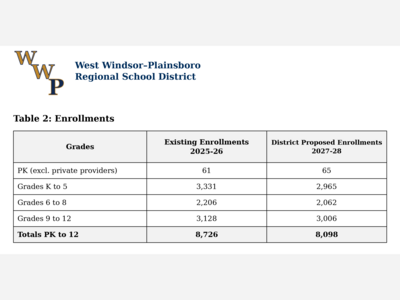
Enrollment has dropped about 10% over 15 years. This is a trend not unusual for other districts. Adding capacity makes no sense.

I would like to see the Long Range Forecast you cited. I have been tracking enrollment for over 5 years. The 8098 projected enrollment would represent a 17% decrease in enrollment over the past 10 years!
Stephen I sent you 2 emails with all the information. Full disclosure, the information that I sent you came directly from Aderhold or his administration.

I read that Dana Krug is Chairwoman of the Finance Committee of the WW school board, which means to me that she is the right person to respond to Mehno's very reasonable inquiries. My hopes are that Ms. Krug will respond adequately according to her duties and capacity as Chairwoman.
I will give her the benefit of the doubt. But Krug never responds to any inqueries.....she is not approachable nor she cares.

Sunny, with a high of 68 and low of 48 degrees. Sunny for the morning, clear in the afternoon and evening,


Is all of that $54.3M accounted for and where is it?
That is a question that I have been asking Aderhold and I have not received any answer. I do not know where it went.
We taxpayers are fortunate to have Veronica Mehno as such a concerned and knowledgeable member of our community, and I echo her concerns about the expenditures and practices of the West Windsor school administrators.
I hope Aderhold will respond to my complaint submitted to the Education Department. I have been asking the same 2 questions since August 17, 2026 and Aderhold responds by telling me that money surplus can be legally transferred to the capital reserves account.
Would it be able to contact you offline? My name is Dr.Amar Atre. I am running for BOE for WW-P in the coming election. My e-mail is atreboe@gmail.com. Number is 404-617-5969.

I request that Superintendent Aderhold respond to the questions Virginia Mehno raises. And also, why would later school start times result in additional buses and drivers with higher fuel costs?
Enrollment has dropped about 10% over 15 years. This is a trend not unusual for other districts. Adding capacity makes no sense.

Veronica, have any of the following resources been contacted to complete an investigative audit?
The question is not whether the transfers were legal or properly recorded.