Image
WW-P’s Spending Priorities Demand an Independent Review
By Veronica Mehno
Superintendent David Aderhold cannot reasonably ask taxpayers to accept higher taxes because of rising health-insurance costs while pursuing property acquisitions and building additions without fully explaining their necessity. In my view, presenting the financial pressure while failing to provide an equally clear accounting of discretionary spending is disingenuous and misleading.
The district’s own Long-Range Facilities Plan, approved by NJDOE on April 29, 2026, exposes a contradiction that demands answers.
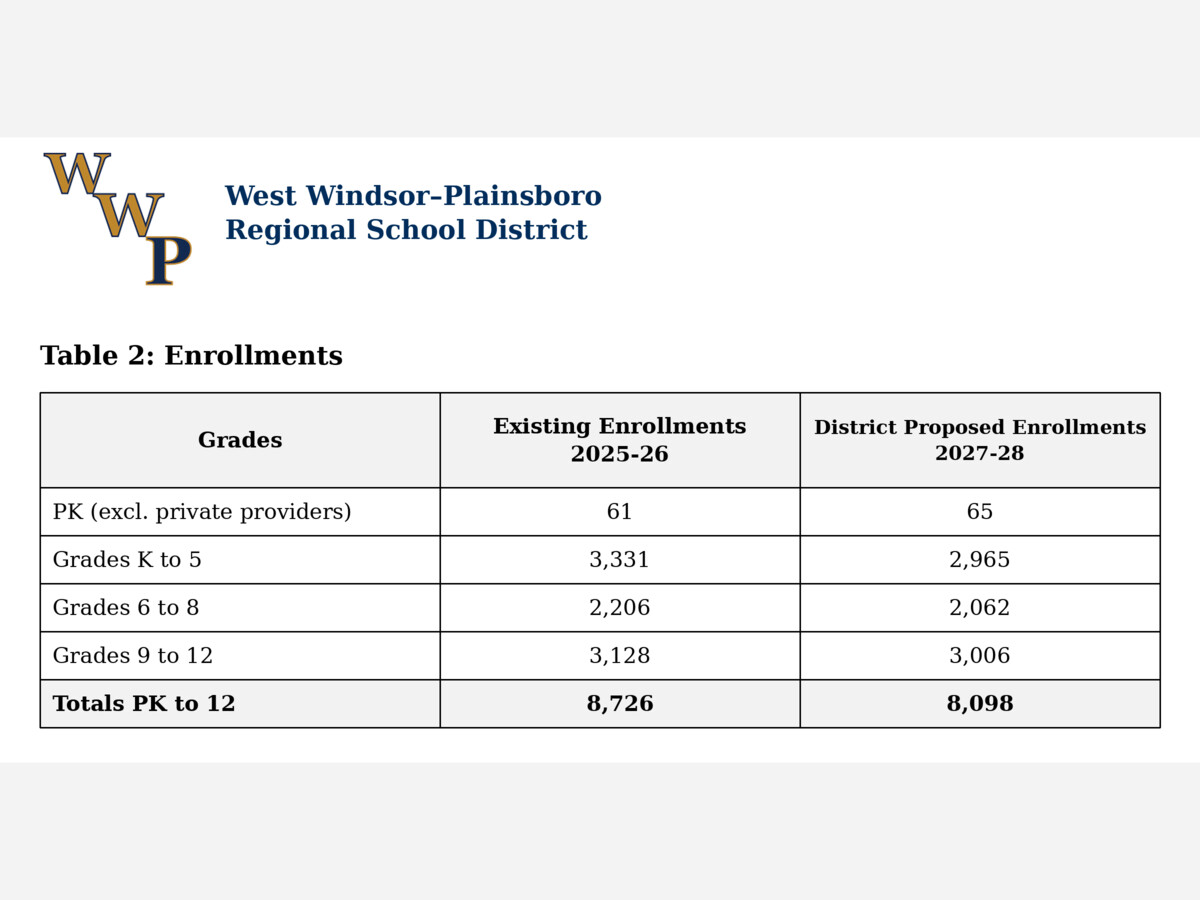
WW-P projects enrollment falling from 8,726 students in 2025–2026 to 8,098 in 2027–2028: 628 fewer students, approximately a 7.2 percent decline. Yet the plan increases its school-building inventory from 10 to 14, its number of schools from 10 to 11, and its sites from 15 to 16.
That does not mean four new schools will be constructed. It does mean the administration anticipates a larger building inventory while serving substantially fewer students. Taxpayers should not have to extract this information from state documents while being told why their taxes must increase.
The same plan identifies existing district practices capacity of approximately 9,453 students, compared with projected enrollment of 8,098—roughly 1,355 seats of surplus capacity.
District-wide capacity does not establish that every classroom is suitable for every program. But it absolutely requires the administration to demonstrate why existing space cannot meet its needs before committing taxpayers to additional facilities.
Instead, the district is pursuing the acquisition of 72 Grovers Mill Road. If the proposed price is $4.25 million, residents deserve the purchase agreement, appraisal, funding source, and a credible lease-versus-purchase analysis. They deserve documented savings and a full accounting of future maintenance and operating costs.
The plan also lists Wicoff Elementary School for renovations and a building addition. The administration must explain whether this reflects earlier work or a new commitment. If new construction is contemplated, where is the documented need, the cost estimate, and the analysis of alternatives?
These are basic requirements of responsible financial management. They should precede spending decisions, not follow persistent demands from residents.
Rising insurance costs may be real. That does not make every proposed expenditure necessary, and it does not excuse presenting taxpayers with an incomplete picture of the district’s finances. A budget presentation that emphasizes unavoidable pressures while leaving major discretionary commitments insufficiently explained can mislead the community about the choices actually available.
I believe Aderhold and his administration should be subject to an independent review of their budgeting practices, capital-planning decisions, and public financial representations. That review should examine whether information presented to residents has been accurate, complete, and consistent with the district’s audited results and facilities projections.
The Board of Education’s oversight should also be examined. Board members have a responsibility to demand evidence, challenge assumptions, and protect public funds. Accepting administrative recommendations without making the supporting analysis clear to taxpayers is inadequate oversight.
NJDOE’s approval of the facilities plan provides no blanket endorsement of these spending decisions. Its letter expressly states that approval of the plan does not constitute approval of individual projects or their costs. Invoking state approval cannot replace a public demonstration of necessity and value.
Until the administration produces that evidence, I consider these priorities fiscally irresponsible and insufficiently justified. Our hard-earned tax dollars should not be committed to an expanding property portfolio without a convincing explanation of why a shrinking district needs it.
The community deserves more than selective explanations, assurances of prudence, and another tax increase. It deserves independently verified facts, meaningful scrutiny, and accountability from the superintendent, his administration, and the board that oversees them.



I would like to see the Long Range Forecast you cited. I have been tracking enrollment for over 5 years. The 8098 projected enrollment would represent a 17% decrease in enrollment over the past 10 years!
Stephen I sent you 2 emails with all the information. Full disclosure, the information that I sent you came directly from Aderhold or his administration.

Sunny, with a high of 65 and low of 49 degrees. Sunny in the morning, clear for the afternoon and evening,

I read that Dana Krug is Chairwoman of the Finance Committee of the WW school board, which means to me that she is the right person to respond to Mehno's very reasonable inquiries. My hopes are that Ms. Krug will respond adequately according to her duties and capacity as Chairwoman.
I will give her the benefit of the doubt. But Krug never responds to any inqueries.....she is not approachable nor she cares.


Is all of that $54.3M accounted for and where is it?
That is a question that I have been asking Aderhold and I have not received any answer. I do not know where it went.
We taxpayers are fortunate to have Veronica Mehno as such a concerned and knowledgeable member of our community, and I echo her concerns about the expenditures and practices of the West Windsor school administrators.
I hope Aderhold will respond to my complaint submitted to the Education Department. I have been asking the same 2 questions since August 17, 2026 and Aderhold responds by telling me that money surplus can be legally transferred to the capital reserves account.
Would it be able to contact you offline? My name is Dr.Amar Atre. I am running for BOE for WW-P in the coming election. My e-mail is atreboe@gmail.com. Number is 404-617-5969.

I request that Superintendent Aderhold respond to the questions Virginia Mehno raises. And also, why would later school start times result in additional buses and drivers with higher fuel costs?
Enrollment has dropped about 10% over 15 years. This is a trend not unusual for other districts. Adding capacity makes no sense.

Veronica, have any of the following resources been contacted to complete an investigative audit?
The question is not whether the transfers were legal or properly recorded.