For months, I have asked Superintendent David Aderhold two straightforward questions about the West Windsor-Plainsboro Regional School District’s finances:
Why did the district budget approximately $40.9 million more for health benefits than it ultimately spent over eight consecutive years?
Where, specifically, did that money go?
These are not complicated questions. They are not accusations of fraud, and they are not personal attacks. They are reasonable questions from a taxpayer and parent about tens of millions of public dollars.
Yet despite multiple requests and ample opportunity to respond, Superintendent Aderhold has not provided a direct, year-by-year accounting.
Instead, the administration has offered general explanations about the unpredictability of health-insurance costs, statutory spending limitations and the district’s legal authority to transfer surplus funds. But explaining what the district is legally permitted to do does not answer why the same significant favorable variance occurred for eight consecutive years. It also does not tell taxpayers where the resulting funds were ultimately allocated.
After repeatedly requesting answers and receiving none, I had no reasonable choice but to file a formal complaint with the New Jersey Department of Education’s Office of Fiscal Accountability and Compliance against Superintendent Aderhold and his administration.
That escalation could have been avoided. All the superintendent had to do was provide a transparent accounting.
The most serious concern involves transfers into capital reserve. Once money is transferred into that account, it becomes restricted for capital purposes. The superintendent must obtain Board of Education approval before it can be spent, but that does not necessarily provide meaningful community involvement.
By the time a particular purchase or project appears on a Board agenda, the money may have already been accumulated and restricted. Residents can speak during public comment, but the public does not vote on the recommendation. The nine-member Board can approve the administration’s proposal without obtaining the broader community’s consent.
That is not illegal, but it creates a dangerous concentration of financial decision-making—especially when the administration refuses to explain clearly how much money was transferred, where it originated and why it was placed beyond the reach of other district priorities.
The consequences are visible.
In 2024, the district purchased approximately 28 acres of farmland for approximately $3.9 million. The administration is now considering another potential real-estate acquisition at 72 Grovers Mill Road, but the proposed purchase price has not been publicly disclosed.
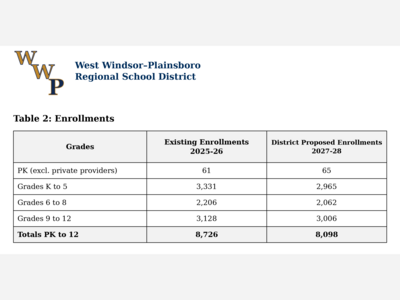
At the same time, district enrollment has declined by approximately 723 students.
Why is a district with hundreds fewer students continuing to expand its real-estate holdings? What is the long-term plan for these properties? What will their acquisition, development and maintenance ultimately cost taxpayers?
These questions become even more important when parents are told that other priorities cannot be pursued because of cost.
Parents have repeatedly asked the district to consider a later start to the school day. Superintendent Aderhold has cited the additional costs of transportation, bus drivers and fuel as obstacles. Yet the administration continues recommending that money be restricted for capital purposes and that the district acquire more real estate.
Capital-reserve funds cannot be used to pay recurring operating expenses such as bus-driver salaries after the money has been restricted. That is precisely the point: the original decision to move available funds into capital reserve determines which priorities will be possible in the future and which will be dismissed as unaffordable.
Those decisions should not occur without full public disclosure and meaningful community discussion.
This pattern is particularly troubling because the district accumulated approximately $40.9 million in favorable health-benefit budget variances over eight consecutive years while taxpayers were asked to absorb tax-levy increases exceeding 2% in three consecutive budget years.
Eight consecutive years is not an isolated forecasting error. It is a recurring pattern that deserves independent scrutiny.
The community deserves to know:
- How much was budgeted for health benefits each year?
- How much was actually spent?
- Where did each year’s favorable variance go?
- How much was transferred into capital reserve or other reserve accounts?
- How much was used for other expenditures or retained as fund balance?
- How did these recurring surpluses affect the administration’s decisions to increase the tax levy?
- Why is the district acquiring additional property while enrollment is declining?
Superintendent Aderhold frequently speaks about transparency, fiscal responsibility and community engagement. But transparency is not demonstrated through slogans or broad explanations. It requires answering specific questions with specific facts.
A superintendent cannot claim to welcome community involvement while refusing to answer documented questions about tens of millions of taxpayer dollars. An administration cannot define transparency as providing only the information it is comfortable discussing.
I did not rush to file a formal complaint. I asked the superintendent directly, repeatedly and publicly. I gave him every opportunity to provide the requested accounting.
He chose not to do so.
Therefore, I have formally asked the New Jersey Department of Education to conduct an independent review of the district’s health-benefit budgeting methodology, the disposition of the approximately $40.9 million in favorable variances, the transfers into capital reserve, the tax-levy increases and the district’s real-estate acquisitions.
This complaint does not presume that any law was broken. It asks the state to examine a recurring fiscal pattern that the administration has been unwilling to explain.
When local officials provide clear answers, outside intervention should not be necessary. But when a superintendent refuses to answer reasonable questions involving tens of millions of public dollars, taxpayers have both the right and the responsibility to seek those answers elsewhere.
The community’s money is not the administration’s money. Taxpayers deserve a complete accounting—and we should not have to file a state complaint to obtain it.
 60° and Clear